What to know about block coding for kids – The visual coding language that took coding from the few to the many
Coding for Kids
You have probably heard about coding. If you haven’t, coding is the instructions people write in order to tell computers what to do. Since coding has become very trendy in the last couple of years, the awareness for it has grown exponentially. What was once viewed as a skill for only a select few has transformed into a subject that any teacher can bring into their classroom. In other words – today students as young as 8 learn to code and even excel in it!
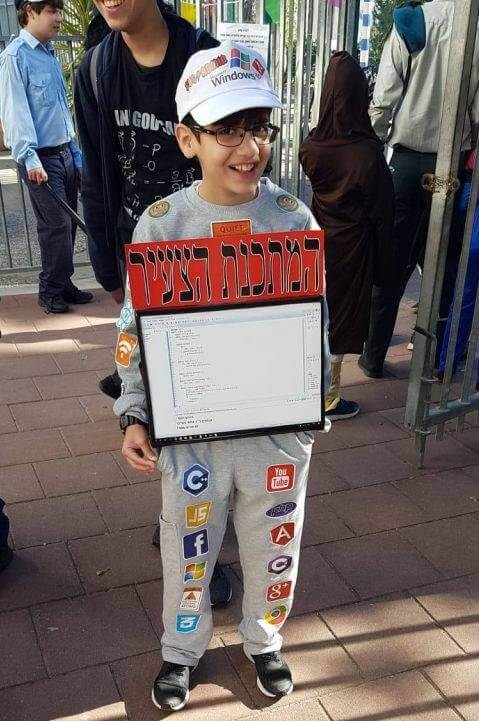
There are many cases where young students have shown real skill in the subject. For example, an 11 year-old boy named Yoav first got into coding through CodeMonkey and now teaches coding and is studying it at a university! Yes, he is only 11 years-old and is probably a genius, but the fact that students are learning to code from a young age has exposed him to the subject and helped him discover his talent early on. This is no small feat and today making computer programming accessible is the goal of many coding initiatives throughout the world. With so many great resources available, text-based and block coding for kids has become commonplace.
11-year-old Yoav dressing up as a programmer
Yoav with his report card from the Open University in Israel
Where did Block-based coding begin?
You may be wondering when students first started learning the skill that has until recently been viewed as relevant only for adolescents and adults. It all started in 2003, when MIT developed the first basic computer language, known as Scratch, that was intended to teach kids to code. Since then, coding has garnered a new reputation – anyone can and should learn to code!
To put this into perspective, today toddler coding classes have become a must-have for nurseries in the UK. In the past, people would have thought this to be impossible but with the UK looking to develop more skills in toddlers, coding jumped to the top of the list. More and more parents alike want to future-proof their children with coding skills. Parent and MAMA.codes founder Liane Katz even went as far as calling coding a “21st century superpower.”
More on Scratch – Code Blocks
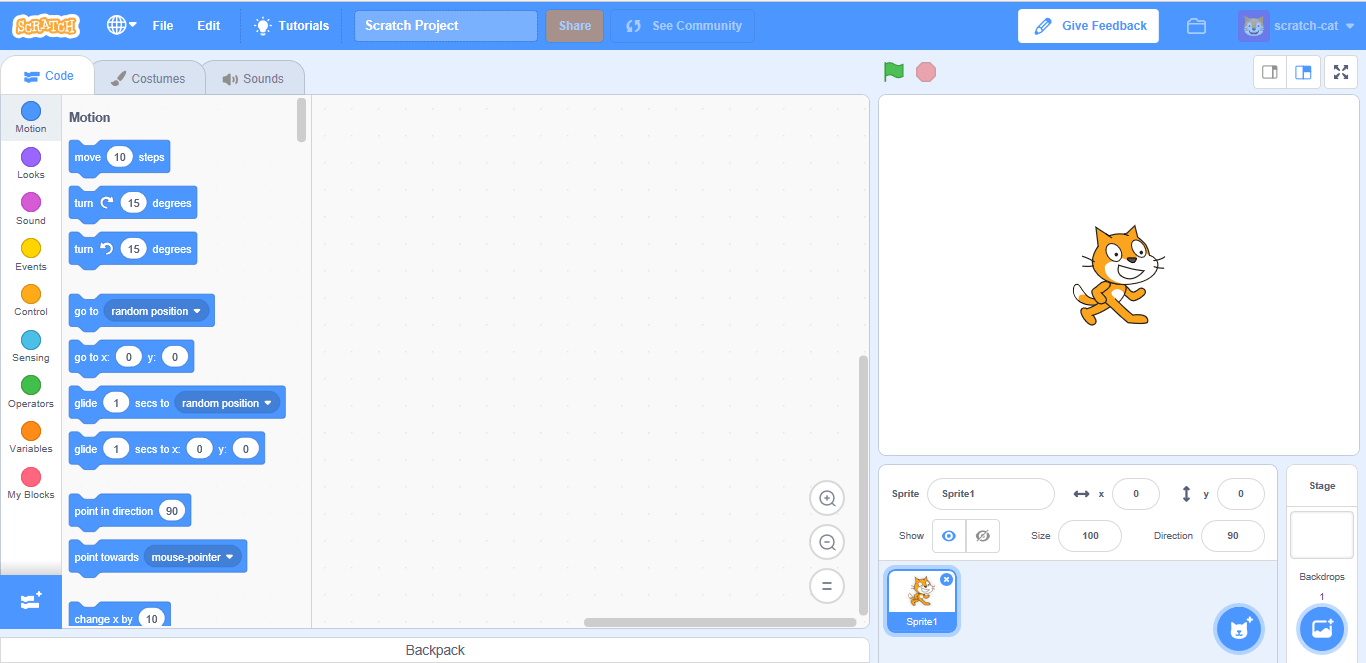
Scratch was the first block coding language, meaning that the lines of code are written on blocks that students can drag and drop in order to build games and other visual projects. The revolution that Scratch introduced was the belief that young students can easily learn programming when they do not have to write out the code itself. Writing text-based code can be tricky because every piece of syntax matters and can disrupt the program from running. If a student forgets just one space, comma, or period, their entire code will not work. Scratch does not require students to write which solves the issue of writing-based errors.
Scratch 3.0 shows how the Scratch code blocks are like a puzzle that students can arrange in any order they want.
Block-based coding is great for younger students who cannot write. However, once students are comfortable with writing short sentences, they should be ready for a text-based programming language. Today, there are many text-based coding languages such as CoffeeScript and Python that are used in the workplace that students can learn in a fun game-based environment. These languages have an easy syntax so students are less likely to get frustrated. The benefit of learning a text-based language is that it develops the skill of coding and paves the way for students to then easily learn other coding languages.
Block Coding Websites
You can introduce coding to your preschoolers and kindergarteners through block-based coding. CodeMonkey, previously known as a text-based coding platform, has recently released its first block-based course for 4-6 year olds. Block-based coding games are perfect for preschoolers because they are still learning their ABC’s.
CodeMonkey Jr. is a pre-coding course that uses graphical blocks to program a monkey so it can catch bananas and unlock a treasure chest. The instructions (or arrows) in the game are represented in blocks that preschoolers arrange in a row to tell the monkey which way to walk and jump. Along the way, preschoolers learn logic, algorithms, sequencing, loops, counting, direction and orientation.
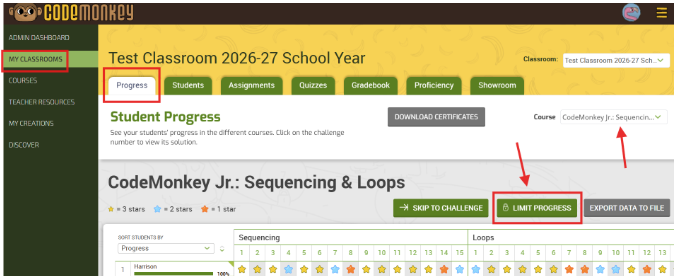
While Scratch Jr. is a block coding website and app where 5-7 year olds create their own interactive stories and games, CodeMonkey Jr. is a self-paced game with an intuitive interface that teaches pre-coding to 4-6 year olds. CodeMonkey Jr. is also designed to be taught in the classroom, with block coding lessons in the works.
Scratch Jr. Interface
CodeMonkey Jr. Interface
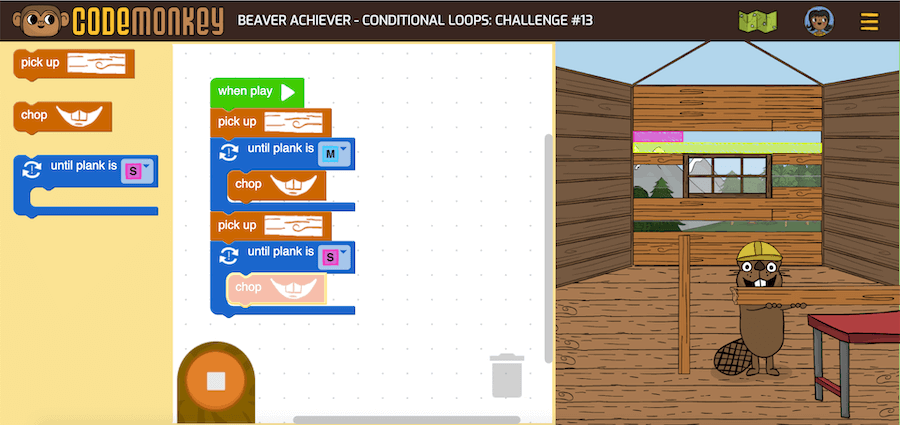
There are also block coding websites for older students. CodeMonkey offers a new block coding course for 1st and 2nd graders called Beaver Achiever.
Teach your students coding concepts with Beaver Achiever
The most important part about block coding for kids, is that it broke the misconception that coding is only for adults. With the right courses, coding can even feel like a game for kids. Although block coding is not a substitute for real (text-based) code as it has its limitations, it bridges the gap so younger students can learn about coding sooner.
The benefits of block-based coding are that it teaches students how to give clear instructions and organize their thoughts in the form of writing sequences. Block coding also helps young children practice coding concepts and computational thinking. We recommend trying block coding out with your young ones, who knows – maybe they will grow up to be the next Mark Zuckerberg!
Stay Up To Date on The Latest NEWS AND LEARN MORE ABOUT CODING FOR KIDS.
We use cookies on our website to give you the most relevant experience by remembering your preferences and repeat visits. By clicking “Accept”, you consent to the use of ALL the cookies. However you may visit Cookie Settings to provide a controlled consent.
This website uses cookies to improve your experience while you navigate through the website. Out of these cookies, the cookies that are categorized as necessary are stored on your browser as they are essential for the working of basic functionalities of the website. We also use third-party cookies that help us analyze and understand how you use this website. These cookies will be stored in your browser only with your consent. You also have the option to opt-out of these cookies. But opting out of some of these cookies may have an effect on your browsing experience.
Necessary cookies are absolutely essential for the website to function properly. This category only includes cookies that ensures basic functionalities and security features of the website. These cookies do not store any personal information.
Cookie
Type
Duration
Description
_codemonkey_session_rails_4
1
1 year
_ga
persistent
2 years
This cookie is installed by Google Analytics. The cookie is used to calculate visitor, session, campaign data and keep track of site usage for the site's analytics report. The cookies store information anonymously and assign a randomly generated number to identify unique visitors.
cookielawinfo-checkbox-advertisement
persistent
11 months
The cookie is set by GDPR cookie consent to record the user consent for the cookies in the category "Advertisement".
cookielawinfo-checkbox-analytics
persistent
11 months
This cookies is set by GDPR Cookie Consent WordPress Plugin. The cookie is used to remember the user consent for the cookies under the category "Analytics".
cookielawinfo-checkbox-functional
persistent
11 months
cookielawinfo-checkbox-necessary
persistent
11 months
This cookie is set by GDPR Cookie Consent plugin. The cookies is used to store the user consent for the cookies in the category "Necessary".
cookielawinfo-checkbox-non-necessary
0
11 months
This cookie is set by GDPR Cookie Consent plugin. The cookies is used to store the user consent for the cookies in the category "Non Necessary".
cookielawinfo-checkbox-other
persistent
11 months
cookielawinfo-checkbox-performance
persistent
11 months
This cookie is used to keep track of which cookies the user have approved for this site.
JSESSIONID
1
1 year
Used by sites written in JSP. General purpose platform session cookies that are used to maintain users' state across page requests.
viewed_cookie_policy
persistent
1 hour
The cookie is set by the GDPR Cookie Consent plugin and is used to store whether or not user has consented to the use of cookies. It does not store any personal data.
XSRF-TOKEN
persistent
1 year
The cookie is set by Wix website building platform on Wix website. The cookie is used for security purposes.
Any cookies that may not be particularly necessary for the website to function and is used specifically to collect user personal data via analytics, ads, other embedded contents are termed as non-necessary cookies. It is mandatory to procure user consent prior to running these cookies on your website.
Cookie
Type
Duration
Description
rlas3
persistent
11 months
The cookie is set by rlcdn.com. The cookie is used to serve relevant ads to the visitor as well as limit the time the visitor sees an and also measure the effectiveness of the campaign.
UserMatchHistory
persistent
1 month
Linkedin - Used to track visitors on multiple websites, in order to present relevant advertisement based on the visitor's preferences.
This cookie is set by Google Analytics and is used to distinguish users and sessions. The cookie is created when the JavaScript library executes and there are no existing __utma cookies. The cookie is updated every time data is sent to Google Analytics.
__utmb
persistent
30 minutes
The cookie is set by Google Analytics. The cookie is used to determine new sessions/visits. The cookie is created when the JavaScript library executes and there are no existing __utma cookies. The cookie is updated every time data is sent to Google Analytics.
__utmc
persistent
1 year
The cookie is set by Google Analytics and is deleted when the user closes the browser. The cookie is not used by ga.js. The cookie is used to enable interoperability with urchin.js which is an older version of Google analytics and used in conjunction with the __utmb cookie to determine new sessions/visits.
__utmt
persistent
10 minutes
The cookie is set by Google Analytics and is used to throttle request rate.
__utmz
persistent
6 months
This cookie is set by Google analytics and is used to store the traffic source or campaign through which the visitor reached your site.
_gat
persistent
1 minute
This cookies is installed by Google Universal Analytics to throttle the request rate to limit the colllection of data on high traffic sites.
YSC
1
1 year
This cookies is set by Youtube and is used to track the views of embedded videos.
This cookie is used by Google Analytics to understand user interaction with the website.
_gid
persistent
1 day
This cookie is installed by Google Analytics. The cookie is used to store information of how visitors use a website and helps in creating an analytics report of how the wbsite is doing. The data collected including the number visitors, the source where they have come from, and the pages viisted in an anonymous form.
GPS
persistent
30 minutes
This cookie is set by Youtube and registers a unique ID for tracking users based on their geographical location
MR
persistent
5 months
This cookie is used to measure the use of the website for analytics purposes.
MUIDB
1
1 year
This cookie is used by MicroSoft and collects data about users of visits on multiple website. This data is used to analyze the efficiency of advertisements on websites.
This cookie is set by Facebook to deliver advertisement when they are on Facebook or a digital platform powered by Facebook advertising after visiting this website.
bscookie
1
2 years
This cookie is a browser ID cookie set by Linked share Buttons and ad tags.
fr
1
3 months
The cookie is set by Facebook to show relevant advertisments to the users and measure and improve the advertisements. The cookie also tracks the behavior of the user across the web on sites that have Facebook pixel or Facebook social plugin.
IDE
1
2 years
Used by Google DoubleClick and stores information about how the user uses the website and any other advertisement before visiting the website. This is used to present users with ads that are relevant to them according to the user profile.
MUID
persistent
1 year
Used by Microsoft as a unique identifier. The cookie is set by embedded Microsoft scripts. The purpose of this cookie is to synchronize the ID across many different Microsoft domains to enable user tracking.
pxrc
persistent
2 months
The purpose of the cookie is to identify a visitor to serve relevant advertisement.
rlas3
persistent
11 months
The cookie is set by rlcdn.com. The cookie is used to serve relevant ads to the visitor as well as limit the time the visitor sees an and also measure the effectiveness of the campaign.
skimCSP
persistent
11 months
This cookie is set by SkimResources. The cookie is used to record data on the visitor to optimize the relevance of the advretisements served to the users.
TapAd_DID
persistent
2 months
The cookie is set by tapad.com. The purpose of the cookie is to track users across devices to enable targeted advertising
TapAd_TS
persistent
2 months
The cookie is set by Tapad.com. The purpose of the cookie is to track users across devices to enable targeted advertising.
TDCPM
persistent
1 year
The cookie is set by CloudFare service to store a unique ID to identify a returning users device which then is used for targeted advertising.
TDID
persistent
1 year
The cookie is set by CloudFare service to store a unique ID to identify a returning users device which then is used for targeted advertising.
test_cookie
persistent
15 minutes
This cookie is set by doubleclick.net. The purpose of the cookie is to determine if the users' browser supports cookies.
VISITOR_INFO1_LIVE
1
5 months
This cookie is set by Youtube. Used to track the information of the embedded YouTube videos on a website.