Education used to be quite slow-moving, with only minor changes taking place in the classroom year by year. But nowadays, that couldn’t be further from the truth — schools are modernizing fast. From Artificial Intelligence to Virtual Reality, these technology trends are changing the face of 21st-century education.
We’re feeling quite excited by it all. Hopefully, you are too.
Artificial Intelligence
Teachers won’t be replaced by robots any time soon — at least, not that we’re aware of — but artificial intelligence does have a place in modern classrooms.
One of the most exciting uses is the automatic grading of homework papers, which would save a teacher hundreds of hours over the course of an academic year. AI assistants, similar to Amazon’s Alexa, are also being trialed in modern schools. Merlyn is designed to manage a classroom’s laptops, lights, and projectors, leaving the teacher free to focus on the students while the assistant deals with the tech.
Artificial Intelligence can also be used to create personalized learning plans for students, which is something a teacher doesn’t often have time for. By looking at a student’s recent tests and homework papers, the AI can spot any gaps in their knowledge, and prepare a lesson designed specifically for them.
Big data & Analytics
Big data is a term on everyone’s lips. It describes the sheer amount of information that can now be collected about an individual, from the number of times they use their phone, to the amount of money they spend in a week, to the number of steps they take in an hour, and a million other things too.
In a classroom setting, big data could be used to better keep track of student performance, especially in relation to different methods of teaching. Was a student more engaged during a slideshow lecture or as part of a class discussion? Were they more productive first thing in the morning, or straight after lunch?
Armed with all this valuable data, teachers can start to adapt their lessons to better fit their students’ needs. Or maybe, even better — an AI assistant could do it for them.
Big data can also improve education on a larger scale, by helping to demonstrate school-wide and even nationwide trends. Who knows: maybe students across the whole of America perform better when math is on a Monday as opposed to a Friday. If that was the case, the national curriculum could change.
Remote learning
During the coronavirus pandemic, schools around the world were forced to close their doors and switch to a remote learning model.
A few years ago, this wouldn’t have been possible. The technology simply wasn’t available. But luckily enough, the transition proved to be relatively simple, thanks to a variety of modern edtech solutions, like interactive classrooms and video conferencing.
Even though the pandemic is over, remote learning is still continuing to rise. The e-learning market is predicted to grow by 15% every year between 2020 and 2025, reaching a total value of $50 billion. It lets children in rural areas access teaching which wouldn’t have otherwise been available to them. It lets university students attend classes and lectures without needing to move away from home. Of all the trends we’ve identified, this is probably the most pronounced.
Cloud learning
Cloud learning is closely linked to remote learning. In basic terms, it allows students (and teachers) to access their work from any location, at any time — as long as they have internet access.
This is a pretty big deal, especially for teachers. If students are saving all their work on the cloud, and teachers also have access to that cloud, it makes the process of marking a lot less daunting. Instead of lugging home a pile of crumpled worksheets, a teacher can simply access the work on their laptop.
Even better, there’s no chance of a student forgetting to bring their homework to school, or forgetting to bring the worksheet home in the first place. It’s all on the cloud, and that makes life easier for everyone involved, teachers and students alike. It’s better for the environment too: a lot less wasted paper.
Blockchain technology
Just like big data, blockchain is a bit of a buzzword at the moment. Basically, it’s a way to structure data in a safer, more secure way.
The term is mainly used in the context of banking and cryptocurrencies, and you might not have heard it used in relation to education. But blockchain technology is an excellent way to manage student records. These blockchain records can’t be hacked or modified, which makes them easy to validate, and virtually impossible to fake.
In other words, students won’t be able to fake their credentials, or lie about their grades, when applying to jobs or further education. They won’t be able to lose their grades either, which can sometimes happen with a physical, paper certificate. Overall, blockchain streamlines the entire system and makes everything more honest and transparent.
Gamification
Gamification, in simple terms, is about making learning more enjoyable. Education doesn’t need to be dry and boring. Students learn best when they’re having fun. That’s what gamification is about: delivering lessons in the form of games.
This idea isn’t anything new. Teachers have been using games for years, running class quizzes and competitive challenges and other gamified learning. But technological improvements are taking gamification to a whole new level. There are more and more educational video games out there, such as Minecraft’s groundbreaking Education Edition.
It’s fun and engaging, and a great way to learn. Maybe this is the future of schooling: groups of children playing games together without even realizing they’re learning. There’s a lot of money in educational games, and plenty of studios are already starting to follow Minecraft’s lead.
Virtual Reality
Immersive experiences have always been an amazing way to enhance a child’s learning. Going down to the beach, and looking at stones, is a much better way to study geography than reading about stones in a textbook.
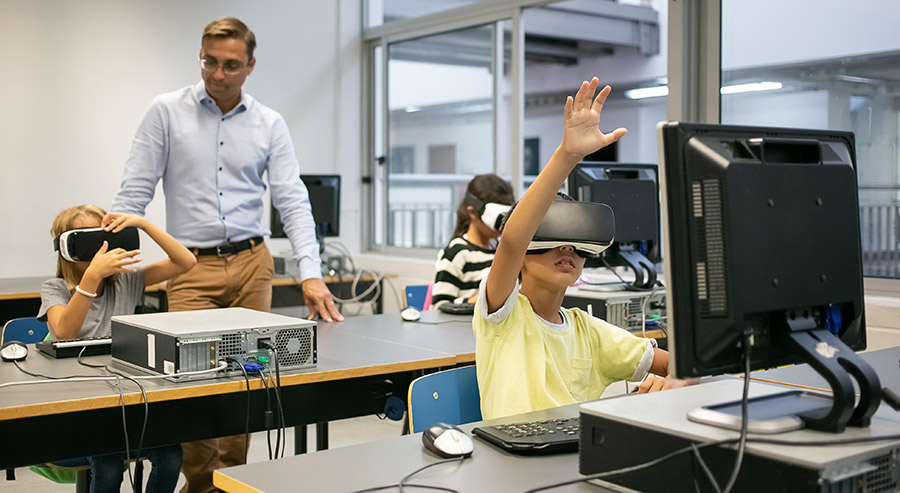
Not so long ago, an example like this would only have been possible for students who happened to live close to a beach. Inner city students, in the middle of the country, would have to make do with the textbook instead. But virtual reality is beginning to change that. Wherever you are in the world, you can use VR to visit geographical field sites, explore historical buildings, and take part in science experiments.
It still doesn’t match the real experience, but it isn’t far off, and it’s definitely better than looking at photos in a textbook. More and more, VR will help to bring school subjects to life, transporting students into situations they have never encountered before. This technology has other uses too, like giving students a chance to practice speaking in front of a virtual audience. It’s a great way to boost a child’s confidence in a safe, virtual space.
STEAM
You’ve probably heard of STEM subjects: Science, Technology, Engineering and Math. Since the 1990s, these subjects have been pushed as a way to prepare children for the increasingly technological world. More and more jobs are STEM-related, and schools have tried to follow this trend.
But in the last few years, STEM has started to fade in popularity, with people talking about STEAM instead. It’s the same acronym as before, but with Art thrown into the mix. Even in our modern, technological world, it’s still important for students to learn art-related skills, like creativity, empathy, and collaboration.
These skills work well together: science and art, technology and creativity, or engineering and empathy. Subjects like coding are extremely creative, as we’ve spoken about in the past. There’s no reason why students can’t learn both, and that’s what STEAM is all about.
Long term learning
In the not-so-distant past, there was a clear line between your life at school and your life as an adult. The first part of your life was all about learning, and the rest of your life was about putting that learning into action.
That’s no longer the case. Over the past few years, there has been a massive increase in adult learning, often through apps and websites. Adults can take courses on websites like Udemy, learn a language on an app like Duolingo, study history on a platform like Kinnu, and there are hundreds of other examples.
Long-term learning helps to take the pressure off traditional schooling, as there’s no longer such an obligation to teach a student everything they need to know. Even if they leave with some gaps in their knowledge, there are ways for them to fill those gaps in the future. Just download an app, and suddenly they’re back at school.
Nano-learning
You might not have heard this term before, but we’re pretty sure you’ll be hearing a lot of it in the next few years. It’s the idea of using quick, efficient, bite-sized lessons, instead of the long-form classes a lot of us are used to.
This is how students consume information outside of school. Not in long-form chunks, but in short, sharp bursts. That’s what the popular TikTok platform is built on: micro-videos that impart information in tiny, 15-second packages.
When you’ve grown up with this kind of quickfire format, an hour-long class can feel interminable. That’s where nano-learning comes in. It breaks learning content into smaller pieces, which helps students to engage without getting bored. Don’t worry — this approach isn’t meant to replace traditional long-form lessons entirely. But by scattering in some bite-sized content, the rest of your lesson will be far more likely to engage.
New hardware
Most of the trends we’ve discussed so far have been digital options, rather than physical pieces of technology. But there are also some amazing pieces of hardware that are helping to modernize the classroom.
Smartboards have been around for a while now, but they’re getting better and better with every passing year. They can be used to watch videos, present slideshows, and host games, and they function as excellent whiteboards too. It’s a massive leap forward from the blackboards and chalk which used to be a classroom staple.
As well as this, more and more students are gaining access to laptops and tablets. These can be used for taking notes, hosting ebooks, for playing educational games. It might not be long before certain schools have gone completely paperless. This, surely, is the future.
Final words
Schools are changing fast, and that’s something for us all to be excited about: teachers, students, and parents alike. These technological trends are bringing about some major improvements, which should help to improve the educational experience for every single person involved.
And this is only the beginning. A few years ago, some of these technologies didn’t even exist yet, and there’s no way to know what else is waiting just around the corner. Whatever it is, we’re excited to find out. Tomorrow’s classroom is shaping up to be a really amazing place.
We use cookies on our website to give you the most relevant experience by remembering your preferences and repeat visits. By clicking “Accept”, you consent to the use of ALL the cookies. However you may visit Cookie Settings to provide a controlled consent.
This website uses cookies to improve your experience while you navigate through the website. Out of these cookies, the cookies that are categorized as necessary are stored on your browser as they are essential for the working of basic functionalities of the website. We also use third-party cookies that help us analyze and understand how you use this website. These cookies will be stored in your browser only with your consent. You also have the option to opt-out of these cookies. But opting out of some of these cookies may have an effect on your browsing experience.
Necessary cookies are absolutely essential for the website to function properly. This category only includes cookies that ensures basic functionalities and security features of the website. These cookies do not store any personal information.
Cookie
Type
Duration
Description
_codemonkey_session_rails_4
1
1 year
_ga
persistent
2 years
This cookie is installed by Google Analytics. The cookie is used to calculate visitor, session, campaign data and keep track of site usage for the site's analytics report. The cookies store information anonymously and assign a randomly generated number to identify unique visitors.
cookielawinfo-checkbox-advertisement
persistent
11 months
The cookie is set by GDPR cookie consent to record the user consent for the cookies in the category "Advertisement".
cookielawinfo-checkbox-analytics
persistent
11 months
This cookies is set by GDPR Cookie Consent WordPress Plugin. The cookie is used to remember the user consent for the cookies under the category "Analytics".
cookielawinfo-checkbox-functional
persistent
11 months
cookielawinfo-checkbox-necessary
persistent
11 months
This cookie is set by GDPR Cookie Consent plugin. The cookies is used to store the user consent for the cookies in the category "Necessary".
cookielawinfo-checkbox-non-necessary
0
11 months
This cookie is set by GDPR Cookie Consent plugin. The cookies is used to store the user consent for the cookies in the category "Non Necessary".
cookielawinfo-checkbox-other
persistent
11 months
cookielawinfo-checkbox-performance
persistent
11 months
This cookie is used to keep track of which cookies the user have approved for this site.
JSESSIONID
1
1 year
Used by sites written in JSP. General purpose platform session cookies that are used to maintain users' state across page requests.
viewed_cookie_policy
persistent
1 hour
The cookie is set by the GDPR Cookie Consent plugin and is used to store whether or not user has consented to the use of cookies. It does not store any personal data.
XSRF-TOKEN
persistent
1 year
The cookie is set by Wix website building platform on Wix website. The cookie is used for security purposes.
Any cookies that may not be particularly necessary for the website to function and is used specifically to collect user personal data via analytics, ads, other embedded contents are termed as non-necessary cookies. It is mandatory to procure user consent prior to running these cookies on your website.
Cookie
Type
Duration
Description
rlas3
persistent
11 months
The cookie is set by rlcdn.com. The cookie is used to serve relevant ads to the visitor as well as limit the time the visitor sees an and also measure the effectiveness of the campaign.
UserMatchHistory
persistent
1 month
Linkedin - Used to track visitors on multiple websites, in order to present relevant advertisement based on the visitor's preferences.
This cookie is set by Google Analytics and is used to distinguish users and sessions. The cookie is created when the JavaScript library executes and there are no existing __utma cookies. The cookie is updated every time data is sent to Google Analytics.
__utmb
persistent
30 minutes
The cookie is set by Google Analytics. The cookie is used to determine new sessions/visits. The cookie is created when the JavaScript library executes and there are no existing __utma cookies. The cookie is updated every time data is sent to Google Analytics.
__utmc
persistent
1 year
The cookie is set by Google Analytics and is deleted when the user closes the browser. The cookie is not used by ga.js. The cookie is used to enable interoperability with urchin.js which is an older version of Google analytics and used in conjunction with the __utmb cookie to determine new sessions/visits.
__utmt
persistent
10 minutes
The cookie is set by Google Analytics and is used to throttle request rate.
__utmz
persistent
6 months
This cookie is set by Google analytics and is used to store the traffic source or campaign through which the visitor reached your site.
_gat
persistent
1 minute
This cookies is installed by Google Universal Analytics to throttle the request rate to limit the colllection of data on high traffic sites.
YSC
1
1 year
This cookies is set by Youtube and is used to track the views of embedded videos.
This cookie is used by Google Analytics to understand user interaction with the website.
_gid
persistent
1 day
This cookie is installed by Google Analytics. The cookie is used to store information of how visitors use a website and helps in creating an analytics report of how the wbsite is doing. The data collected including the number visitors, the source where they have come from, and the pages viisted in an anonymous form.
GPS
persistent
30 minutes
This cookie is set by Youtube and registers a unique ID for tracking users based on their geographical location
MR
persistent
5 months
This cookie is used to measure the use of the website for analytics purposes.
MUIDB
1
1 year
This cookie is used by MicroSoft and collects data about users of visits on multiple website. This data is used to analyze the efficiency of advertisements on websites.
This cookie is set by Facebook to deliver advertisement when they are on Facebook or a digital platform powered by Facebook advertising after visiting this website.
bscookie
1
2 years
This cookie is a browser ID cookie set by Linked share Buttons and ad tags.
fr
1
3 months
The cookie is set by Facebook to show relevant advertisments to the users and measure and improve the advertisements. The cookie also tracks the behavior of the user across the web on sites that have Facebook pixel or Facebook social plugin.
IDE
1
2 years
Used by Google DoubleClick and stores information about how the user uses the website and any other advertisement before visiting the website. This is used to present users with ads that are relevant to them according to the user profile.
MUID
persistent
1 year
Used by Microsoft as a unique identifier. The cookie is set by embedded Microsoft scripts. The purpose of this cookie is to synchronize the ID across many different Microsoft domains to enable user tracking.
pxrc
persistent
2 months
The purpose of the cookie is to identify a visitor to serve relevant advertisement.
rlas3
persistent
11 months
The cookie is set by rlcdn.com. The cookie is used to serve relevant ads to the visitor as well as limit the time the visitor sees an and also measure the effectiveness of the campaign.
skimCSP
persistent
11 months
This cookie is set by SkimResources. The cookie is used to record data on the visitor to optimize the relevance of the advretisements served to the users.
TapAd_DID
persistent
2 months
The cookie is set by tapad.com. The purpose of the cookie is to track users across devices to enable targeted advertising
TapAd_TS
persistent
2 months
The cookie is set by Tapad.com. The purpose of the cookie is to track users across devices to enable targeted advertising.
TDCPM
persistent
1 year
The cookie is set by CloudFare service to store a unique ID to identify a returning users device which then is used for targeted advertising.
TDID
persistent
1 year
The cookie is set by CloudFare service to store a unique ID to identify a returning users device which then is used for targeted advertising.
test_cookie
persistent
15 minutes
This cookie is set by doubleclick.net. The purpose of the cookie is to determine if the users' browser supports cookies.
VISITOR_INFO1_LIVE
1
5 months
This cookie is set by Youtube. Used to track the information of the embedded YouTube videos on a website.