Vitaly es el Gerente de Marketing Digital en CodeMonkey. Su maestría en Informática, combinada con su experiencia como padre de dos hijos, le permite crear contenido enfocado en la formación en programación.
In 2014, the United Kingdom became the first country in the entire world to make coding compulsory for elementary students. This raised a lot of eyebrows — why would a child as young as five need to know how to program a computer?
But these eyebrow-raisers failed to recognize the wider benefits of learning to code. It encourages all kinds of transferable skills, like creativity, problem-solving, confidence and communication. Even if these elementary students don’t grow up to be coders and programmers, these other skills are valuable additions to their lives.
Tech literacy
Let’s kick things off with the obvious. Not all of us are computer programmers, but all of us have contact with computers. Some of us (most of us) spend hours on a computer every day, not to mention the time we spend on smartphones, smart watches, smart washing machines, smart televisions. Smart everything, really. Technology is everywhere we look.
When elementary students learn to code, they also learn to feel more confident with computers and technology in general. It’s like learning to swim — as soon as you’ve mastered the basic skills, a pool of water will feel a lot less scary.
In the modern world, technological literacy is all but essential. Some people say it’s as important as learning to read and write. And just like learning to read and write, it’s never too soon to start. That’s why elementary students should learn to code. It’s not the only reason, but it’s a good one.
Resolución de problemas
Life is never straightforward. Problems come up, and it’s important to know how to solve them. The same is true of code. After spending the day working hard on a piece of computer programming, it rarely runs in the way it’s supposed to. Not the first time, anyway. Not until you’ve ironed out the kinks.
Coders call it debugging: finding a problem in a section of code, and working out how to fix it. It takes care, and patience, and attention to detail, and gets easier and easier with practice. Coders soon learn that anger and frustration just make things harder. Instead, they take a deep breath, and calmly solve the issue.
Children who code will carry this approach into the rest of their daily lives. Whether the problem at hand is huge or tiny, long-term or short, it’s always best to remain calm and methodical. That’s what coding shows us.
Resiliencia
This definitely ties in with resolución de problemas, but it’s something slightly different: the ability to bounce back after failure. As we’ve already mentioned, coding never works first try. It’s part of the process — you fail, then try again, you fail, then try again, over and over until everything clicks into place.
Resilience like this, in the face of failure, is something a lot of elementary students struggle with. If they can’t do something on their first attempt, they instantly want to give up, to screw up the page and throw it away, to smash their violin or kick their ball over the hedge. But children who code become tough and resilient in the face of failure. They realize it’s part of the process. Maybe even part of the fun.
Especially when it all pays off. When the program starts to run as planned. The feeling of accomplishment is so thrilling, so rewarding, and the perfect demonstration that those bugs and failures didn’t matter. How could they matter, when you ended on such a high?
Confidence
Coding is also a wonderful way to build a child’s confidence. Younger children (and adults too) are often scared of making mistakes in public. That’s where a lot of shyness and social anxiety comes from. We’re terrified of something going wrong, and the rest of the world judging us for it.
But let’s repeat it again: coding makes children more resilient in the face of failure. They learn that mistakes aren’t the end of the world — and with that knowledge comes increased confidence. Does it matter if we make a mistake in public? No. Not really. No more than it matters when we make a mistake in a line of code.
That thrill of accomplishment, when the code starts to work, is also great for a child’s feeling of self-worth. We all want to feel successful, and skillful, and useful. When our code starts to run in the way we intended, we feel all of these things and more.
Creatividad
We have a tendency to think about computer programming as something dry and mathematical, but that couldn’t be further from the truth. It’s an extremely creative process, and that’s another good reason why kids should start as soon as possible.
We’ve already talked about problem-solving. That’s a type of creativity — when you push yourself to think outside the box. And coding also encourages other forms of creativity. In programs like Rasguño, kids use code to make games and movies. At higher levels, apps and websites require plenty of creativity too. It’s all very visual and artistic.
Unlike a painting, or a drawing, it’s hard to stick a coding project to the refrigerator door. But that doesn’t mean a student won’t want to show it off to their parents. Just look at that character sliding across the screen. At that secret button flashing in the corner. The firework display starts when you press the spacebar.
Coding is creative. Coding is artistic. Coding is a chance for elementary students to express themselves, and to share the results with parents, teachers and friends. This is something we really want to emphasize. It isn’t spoken about enough.
Comunicación
Another common misconception about computer coding is the idea that it’s a solitary pursuit. When we imagine a computer programmer, we usually picture them sitting alone at their computer screen, with nobody else in sight.
It’s certainly true that you can code alone, but you definitely don’t have to. Coding also lends itself well to a team environment, and most professional coders actively prefer to work in groups, where they can bounce ideas back and forth and work together to solve problems. There’s even a term for it: pair programming. When it comes to coding, two heads are better than one.
Elementary students who code collaboratively will pick up important interpersonal skills, like speaking clearly, expressing their opinions, and listening to the thoughts of others. For children who don’t like sports, it’s another way to become part of a cohesive team. A student can pair program with a friend from school. They can try it with a sibling or cousin. They can even do it with a parent — are you willing to give it a try?
Pensamiento computacional
You might not have heard of pensamiento computacional. It’s the idea of thinking less like a person, and more like a computer. A strange idea? Maybe. But really, really useful.
Computers are great at breaking complex topics into smaller, more manageable parts. They focus on these pieces one by one, taking a simple step-by-step approach. That’s how coding works too. It’s always step-by-step, piece-by-piece. We call it decomposition: the process of breaking a large idea into small, workable parts.
This approach works great in all kinds of situations. Getting ready for school is a good example. Instead of feeling overwhelmed (“I have so much to do!”) a computational thinker will work through their tasks in a simple, step-by-step list. First, get out of bed. Second, get dressed. Third, brush teeth. Fourth, eat breakfast. Fifth… you get the idea. This is yet another skill that coding helps with: logical, orderly thought.
Future work
Elementary students are far too young to be planning their future careers. That’s why we decided to put this one towards the bottom of the list. But whatever they end up doing in the future, there’s no harm in getting a small head start by learning some coding skills now.
Computer programmers are in high demand, and by the time our children enter the workplace, this trend will be more pronounced. The demand for coders is expected to grow by 25% in the next ten years, significantly higher than the average rate for careers.
And let’s not forget all those skills we’ve already talked about. Employers love a good problem-solver. They love workers who demonstrate resilience, creativity and strong communication. In other words, even if a child doesn’t end up working as a computer programmer, these other skills will make them more employable.
As we already said: there’s no harm in getting a small headstart. If a kid starts coding at elementary school, they could gather more than a decade’s experience before even leaving high school. Whichever way you look at it, that’s a very impressive feat.
It’s fun!
This is the last point on our list, but that doesn’t make it the least important. Far from it, in fact. Here at CodeMonkey, we firmly believe in the power of fun. Especially where elementary students are concerned.
Children enjoy the chance to be creative. Children enjoy the chance to solve problems. Children enjoy the thrill of success when their coding projects come to life. That’s the best part about coding: picking up all these wonderful skills while having fun along the way. It doesn’t feel like learning. It feels like having fun.
Many of the most effective online coding tools have the look and feel of a video game. Others are narrative-driven — interactive stories that teach children the basic principles. Then there are toys, and board games, and programmable robots, and so many other amazing tools. Coding isn’t dry, or dull, or boring. It’s genuinely enjoyable. Stealth learning at its absolute best.
Final words
Hopefully, after reading all that, you’ll understand why the United Kingdom made coding compulsory for elementary students in 2014. The benefits are hard to ignore. Creativity, confidence, communication, resilience, and so much else as well. A child doesn’t need to grow up to be a computer programmer. Whichever path they take in life, these skills will put them in a strong position to excel.
Because of all this, it should come as no surprise that other countries have started to follow the United Kingdom’s lead. In the last few years, coding has been introduced to elementary curriculums in countries as far-flung as the Philippines, Australia, South Africa, Kenya and Qatar. And even if you live in a country where coding isn’t compulsory yet, there’s nothing stopping your kid from learning to code at home. There are so many wonderful resources out there. Load one of them up, and watch your child shine.
Nuestro mundo actual está experimentando un rápido cambio tecnológico. Esto plantea una pregunta crucial para educadores y directores escolares: ¿cómo podemos preparar a nuestra próxima generación para todas las sorpresas tecnológicas que nos depara el futuro?
Nuestro mundo actual está experimentando un rápido cambio tecnológico. Esto plantea una pregunta crucial para educadores y directores escolares: ¿cómo podemos preparar a nuestra próxima generación para todas las sorpresas tecnológicas que nos depara el futuro?
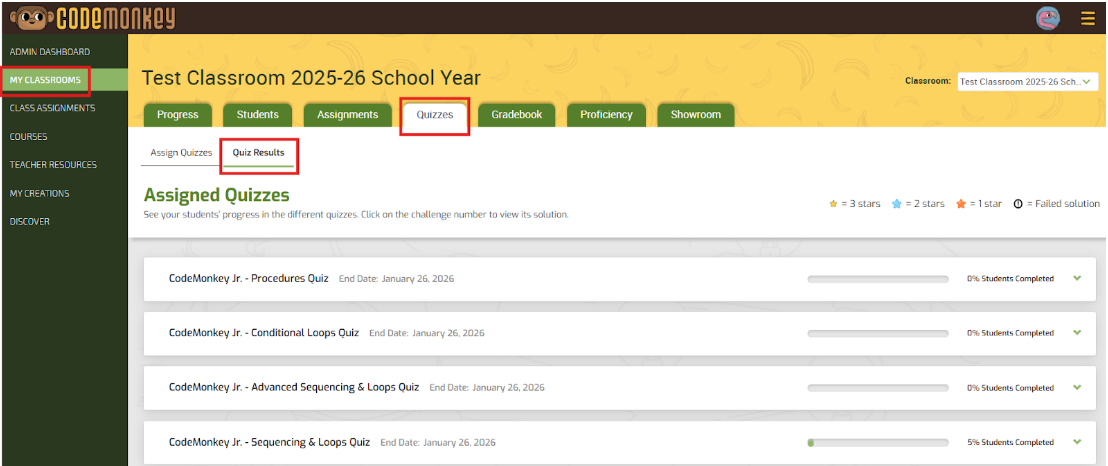
¡Hemos añadido cuestionarios a nuestra biblioteca dirigidos a nuestros prelectores con CodeMonkey Jr.! Hay un cuestionario para cada concepto de programación.
Usamos cookies en nuestro sitio web para brindarle la experiencia más relevante recordando sus preferencias y visitas. Al hacer clic en "Aceptar", acepta el uso de TODAS las cookies. Sin embargo, puede visitar la Configuración de cookies para proporcionar un consentimiento controlado.
Política de privacidad y cookies
Resumen de privacidad
Este sitio web utiliza cookies para mejorar su experiencia mientras navega por el sitio web. Fuera de estas cookies, las cookies que se clasifican como necesarias se almacenan en su navegador, ya que son esenciales para el funcionamiento de las funcionalidades básicas del sitio web. También utilizamos cookies de terceros que nos ayudan a analizar y comprender cómo utiliza este sitio web. Estas cookies se almacenarán en su navegador solo con su consentimiento. También tiene la opción de optar por no recibir estas cookies. Pero la exclusión voluntaria de algunas de estas cookies puede afectar su experiencia de navegación.
Las cookies necesarias son absolutamente esenciales para que el sitio web funcione correctamente. Esta categoría solo incluye cookies que garantizan funcionalidades básicas y características de seguridad del sitio web. Estas cookies no almacenan ninguna información personal.
Galleta
Tipo
Duración
Descripción
_codemonkey_session_rails_4
1
1 año
_Georgia
persistente
2 años
Esta cookie es instalada por Google Analytics. La cookie se utiliza para calcular los datos de visitantes, sesiones y campañas y realizar un seguimiento del uso del sitio para el informe de análisis del sitio. Las cookies almacenan información de forma anónima y asignan un número generado aleatoriamente para identificar visitantes únicos.
cookielawinfo-checkbox-publicidad
persistente
11 meses
La cookie se establece mediante el consentimiento de cookies del RGPD para registrar el consentimiento del usuario para las cookies en la categoría "Publicidad".
cookielawinfo-checkbox-analytics
persistente
11 meses
Estas cookies están establecidas por el complemento de WordPress de consentimiento de cookies de GDPR. La cookie se utiliza para recordar el consentimiento del usuario para las cookies en la categoría "Análisis".
cookielawinfo-checkbox-funcional
persistente
11 meses
cookielawinfo-checkbox-required
persistente
11 meses
Esta cookie está configurada por el complemento de consentimiento de cookies de GDPR. Las cookies se utilizan para almacenar el consentimiento del usuario para las cookies en la categoría "Necesarias".
cookielawinfo-checkbox-no necesario
0
11 meses
Esta cookie está configurada por el complemento de consentimiento de cookies de GDPR. Las cookies se utilizan para almacenar el consentimiento del usuario para las cookies en la categoría "No necesarias".
cookielawinfo-checkbox-otro
persistente
11 meses
cookielawinfo-checkbox-performance
persistente
11 meses
Esta cookie se utiliza para realizar un seguimiento de las cookies que el usuario ha aprobado para este sitio.
JSESSIONID
1
1 año
Utilizado por sitios escritos en JSP. Cookies de sesión de plataforma de propósito general que se utilizan para mantener el estado de los usuarios en las solicitudes de página.
view_cookie_policy
persistente
1 hora
La cookie está configurada por el complemento de consentimiento de cookies de GDPR y se utiliza para almacenar si el usuario ha dado su consentimiento o no para el uso de cookies. No almacena ningún dato personal.
XSRF-TOKEN
persistente
1 año
La cookie la establece la plataforma de creación de sitios web de Wix en el sitio web de Wix. La cookie se utiliza con fines de seguridad.
Las cookies que pueden no ser particularmente necesarias para que el sitio web funcione y se utilizan específicamente para recopilar datos personales del usuario a través de análisis, anuncios y otros contenidos integrados se denominan cookies no necesarias. Es obligatorio obtener el consentimiento del usuario antes de ejecutar estas cookies en su sitio web.
Galleta
Tipo
Duración
Descripción
rlas3
persistente
11 meses
La cookie la establece rlcdn.com. La cookie se utiliza para mostrar anuncios relevantes al visitante, así como para limitar el tiempo que el visitante ve una y también para medir la efectividad de la campaña.
UserMatchHistory
persistente
1 mes
Linkedin: se utiliza para rastrear a los visitantes en múltiples sitios web, con el fin de presentar anuncios relevantes según las preferencias del visitante.
Google Analytics establece esta cookie y se utiliza para distinguir usuarios y sesiones. La cookie se crea cuando se ejecuta la biblioteca JavaScript y no existen cookies __utma. La cookie se actualiza cada vez que se envían datos a Google Analytics.
__utmb
persistente
30 minutos
Google Analytics establece la cookie. La cookie se utiliza para determinar nuevas sesiones / visitas. La cookie se crea cuando se ejecuta la biblioteca JavaScript y no existen cookies __utma. La cookie se actualiza cada vez que se envían datos a Google Analytics.
__utmc
persistente
1 año
Google Analytics establece la cookie y se elimina cuando el usuario cierra el navegador. La cookie no es utilizada por ga.js. La cookie se utiliza para permitir la interoperabilidad con urchin.js, que es una versión anterior de Google Analytics y se utiliza junto con la cookie __utmb para determinar nuevas sesiones / visitas.
__utmt
persistente
10 minutos
Google Analytics establece la cookie y se utiliza para acelerar la tasa de solicitud.
__utmz
persistente
6 meses
Google Analytics establece esta cookie y se utiliza para almacenar la fuente de tráfico o la campaña a través de la cual el visitante llegó a su sitio.
_revólver
persistente
1 minuto
Google Universal Analytics instala estas cookies para acelerar la tasa de solicitud y limitar la recopilación de datos en sitios de alto tráfico.
YSC
1
1 año
Estas cookies son establecidas por Youtube y se utilizan para rastrear las vistas de videos incrustados.
Google Analytics utiliza esta cookie para comprender la interacción del usuario con el sitio web.
_gid
persistente
1 día
Esta cookie es instalada por Google Analytics. La cookie se utiliza para almacenar información sobre cómo los visitantes usan un sitio web y ayuda a crear un informe analítico de cómo está funcionando el sitio web. Los datos recopilados, incluido el número de visitantes, la fuente de donde provienen y las páginas, se muestran de forma anónima.
GPS
persistente
30 minutos
Esta cookie la establece Youtube y registra una identificación única para rastrear a los usuarios según su ubicación geográfica.
SEÑOR
persistente
5 meses
Esta cookie se utiliza para medir el uso del sitio web con fines analíticos.
MUIDB
1
1 año
MicroSoft utiliza esta cookie y recopila datos sobre los usuarios que visitan varios sitios web. Estos datos se utilizan para analizar la eficacia de los anuncios en sitios web.
Facebook establece esta cookie para entregar publicidad cuando están en Facebook o en una plataforma digital impulsada por publicidad de Facebook después de visitar este sitio web.
bscookie
1
2 años
Esta cookie es una cookie de identificación del navegador establecida por los botones de compartir vinculados y las etiquetas publicitarias.
fr
1
3 meses
Facebook configura la cookie para mostrar anuncios relevantes a los usuarios y medir y mejorar los anuncios. La cookie también rastrea el comportamiento del usuario en la web en sitios que tienen píxeles de Facebook o complementos sociales de Facebook.
IDE
1
2 años
Utilizado por Google DoubleClick y almacena información sobre cómo el usuario utiliza el sitio web y cualquier otro anuncio antes de visitar el sitio web. Se utiliza para presentar a los usuarios anuncios que son relevantes para ellos de acuerdo con el perfil del usuario.
MUID
persistente
1 año
Usado por Microsoft como identificador único. La cookie se establece mediante scripts integrados de Microsoft. El propósito de esta cookie es sincronizar la identificación en muchos dominios de Microsoft diferentes para permitir el seguimiento de usuarios.
pxrc
persistente
2 meses
El propósito de la cookie es identificar a un visitante para ofrecer publicidad relevante.
rlas3
persistente
11 meses
La cookie la establece rlcdn.com. La cookie se utiliza para mostrar anuncios relevantes al visitante, así como para limitar el tiempo que el visitante ve una y también para medir la efectividad de la campaña.
skimCSP
persistente
11 meses
SkimResources establece esta cookie. La cookie se utiliza para registrar datos sobre el visitante con el fin de optimizar la relevancia de las ventajas que se ofrecen a los usuarios.
TapAd_DID
persistente
2 meses
La cookie la coloca tapad.com. El propósito de la cookie es rastrear a los usuarios en todos los dispositivos para permitir publicidad dirigida
TapAd_TS
persistente
2 meses
Tapad.com establece la cookie. El propósito de la cookie es rastrear a los usuarios en todos los dispositivos para permitir publicidad dirigida.
TDCPM
persistente
1 año
El servicio CloudFare configura la cookie para almacenar una identificación única para identificar un dispositivo de usuarios recurrentes que luego se utiliza para publicidad dirigida.
TDID
persistente
1 año
El servicio CloudFare configura la cookie para almacenar una identificación única para identificar un dispositivo de usuarios recurrentes que luego se utiliza para publicidad dirigida.
test_cookie
persistente
15 minutos
Esta cookie la establece doubleclick.net. El propósito de la cookie es determinar si el navegador de los usuarios admite cookies.
VISITOR_INFO1_LIVE
1
5 meses
Youtube establece esta cookie. Se utiliza para rastrear la información de los videos de YouTube incrustados en un sitio web.
Esta cookie está configurada por linkedIn. El propósito de la cookie es habilitar las funcionalidades de LinkedIn en la página.
lang
persistente
1 año
Esta cookie se utiliza para almacenar las preferencias de idioma de un usuario para ofrecer contenido en ese idioma almacenado la próxima vez que el usuario visite el sitio web.
lidc
persistente
1 día
LinkedIn establece esta cookie y la utiliza para el enrutamiento.