Ilya is the Marketing Manager at CodeMonkey. Passionate about educational technology and digital learning, he focuses on making coding accessible and engaging for students worldwide.
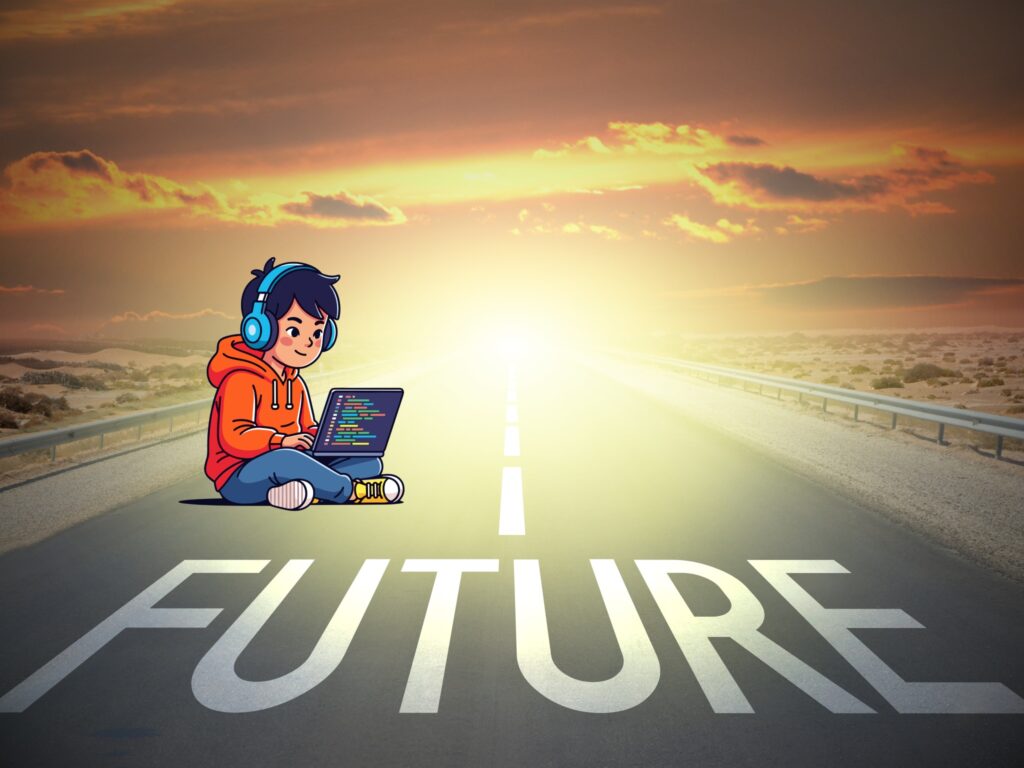
Future-Proof Skills: Why Kids Should Learn Coding Today
Our world today is undergoing a rapid technological change. Tools and devices that did not exist even five years ago are now shaping the way we communicate, work and solve problems. It affects all individuals but especially affects children. Which raises a very important question for educators and school leaders – how can we prepare our next generation for all the technological surprises the future holds?
There are many important skills we can talk about with regards to future readiness, but no matter how you look at it, there’s always one skill that stands out – coding. People nowadays are beginning to understand that coding is much more than a technical specialty, which can only be used in software development or engineering. Coding these days is almost a philosophy – a way of thinking that helps students approach problems methodically, understand issues and systems and adapt to new challenges. That’s why coding today is one of the most important and future-proof skills a child can learn.
As a teacher or an educator, it is very hard for you to predict which jobs will exist or still be relevant in twenty years. But you can teach your students skills that will remain valuable even in an ever-changing and evolving technological world. With a thoughtful approach, teaching coding can support not only academic growth but equip the students with a valuable skill set that will help them compete across a wide range of fields.
What Makes a Skill “Future-Proof”?
Future-proof skills are ones that keep being relevant even when industries change the tools they are using. That’s why a “single-purpose” technical skill, which is usually tied to specific software or platform, can easily become obsolete. That is not the case with coding, though, because programming is a skill that has multiple competencies, and can persist over time.
When students learn how to code, they also learn a lot of parallel skills – how to break a big complex problem into manageable smaller ones, how to test solutions, apply a different approach and evaluate the outcome from a lot of angles. All these processes are not limited to coding but can be applied to various important situations in life. That’s why coding is so important – you can use the same skill set in academic research, planning, creative design and everyday decision-making around the house.
Another important aspect of coding is understanding how systems work. Our world is flooded with automation, artificial intelligence tools and algorithms. Seeing the logic behind digital systems is not an optional choice anymore, but a mandatory skill. Even a person who doesn’t write a line of code in their entire life can benefit deeply from understanding how technology affects outcomes and decisions.
That’s why learning to code is more about creating a specific mindset that prefers logic, structure and adaptability, and less about specific programming language or software.
Coding as a modern form of literacy
In ancient times, or even a hundred years ago, literacy meant the ability to read and write. Nowadays the paradigm shifted – we are talking about media literacy, digital literacy and the ability not to get lost in complex information environments. Coding is an integral part of this new paradigm.
Our lives these days is shaped by software. Every day we are using search engines, artificial intelligence, navigation and other apps, digital communication tools, learning and entertainment platforms. All this information is accessed and shared via code, which is why students who know the fundamentals of programming have an edge in better understanding of how these tools are built and how they change our behaviour.
The knowledge of coding shifts students from being passive users of technology to active participants in this process. Instead of just consuming the products they learn how technology can be shaped, modified and improved. This is extremely important when they tackle very sophisticated digital environments.
These skills are crucial in a world where technology plays an always-growing role in shaping opportunities. When students learn to think outside the box, and have a better understanding of how systems function, they develop critical thinking – one of the most important skills a person can have.
Cognitive benefits of learning to code
There are a lot of arguments for teaching coding. One of the strongest lies in its impact on cognitive development. Programming helps strengthen mental habits that support learning. This is relevant across disciplines and for all age levels – kids to adults.
Another benefit of coding is logical thinking. Students learn sequences, recognize patterns and dive deeply into cause-and-effect relationships. All these skills align closely with scientific inquiry and mathematical reasoning.
We can also focus on problem-solving as another core benefit. Coding is not easy and rarely works on the first attempt. That’s why students are encouraged to identify errors, use different approaches and always test new ideas. This process requires adjustment, builds flexibility and teaches the students to turn mistakes into opportunities, rather than see them as failures.
Finally, coding improves focus and attention to small details. Even the smallest mistake can have significant consequences in a program, and that requires a student to carefully review their code and be precise. With time, students learn to think systematically while checking their work and adjusting the pace.
All these cognitive benefits are useful not only in a computer lab. Students who learn how to code often show better persistence, are more organized in general and have better analytical thinking, which helps them in other academic areas and in life in general.
Social and emotional benefits of coding
In addition to cognitive development, coding also teaches important emotional and social skills. When students learn programming, they often need to collaborate and communicate with other students. They also face challenges, which require patience and perseverance. Dealing with bugs in a program teaches resilience. With time, students learn that effort and persistence result in improvement, and this lesson goes far beyond the coding world.
In most coding projects there are opportunities for collaboration. Students work in pairs or in small groups, which lead to sharing ideas, and sometimes – building a solution together. That’s how they learn to communicate better, listen to each other and respect each other.
But most importantly – coding builds confidence. When a student completes a project and sees it function properly, it gives them a strong sense of accomplishment. With time, they turn from passive learners into active creators, which deeply affects motivation and self-esteem.
Early exposure to coding is important
If students are being introduced to coding at an early age, it gives them an opportunity to build familiarity and confidence gradually. It doesn’t mean that you need to teach young children complex programming languages. You just need to focus on foundational concepts that go together with developmental stages.
In childhood and primary grades, it’s better to introduce coding concepts through play-based activities. An example of those can be simple problem-solving tasks, sequencing exercises and pattern recognition. These activities lay the groundwork for more complex coding later and encourage cognitive development.
As students grow up, they can engage with more complex coding exercises, such as loops, conditions and variables. This ignites curiosity and creativity, because students immediately see results from their work.
In high school and upper classes, students can deal with more advanced challenges. They can now learn text-based programming, such as Python, for example, and project-based learning, which allows them to apply coding to real-world situations and problems. Early exposure to coding gives students confidence to deal with advanced problems, rather than being intimidated by them.
The use of coding in STEM and other fields
Coding education is very important because of its versatility. Key concepts of programming can be integrated in science, mathematics, language, even arts.
In mathematics, writing programs can help students solve difficult equations, which results in deeper conceptual understanding and better logical reasoning. In science, coding can be used in simulations or data analysis and help students test hypotheses or interpret results.
In language, coding can be used as a tool for expression, helping students create interactive stories, digital presentations or multimedia projects. In the arts students can use the programming tools to design animations, visual art or even music. Nowadays, it’s hard to find a discipline, in which a knowledge of coding cannot be useful.
Preparing teachers to teach coding
Since coding is a relatively new field, a lot of teachers did not receive a formal training in programming during their own education. That’s why enrichment and other forms of professional development is important, even essential for educators.
Teachers training programs should focus not only on technical skills, but also on instructional strategies. Understanding code and supporting students with different levels of experience is important but also know how to integrate programming into existing curricula.
Another important angle of teachers’ development is collaboration among educators. Teachers need to share resources and lesson ideas to build a supportive learning community. Such an attitude fosters growth and eventually turns the teachers into better educators that help their students to achieve the maximum potential.
Practical challenges of coding
As in every field, coding education has not only benefits, but challenges. There’s a lot to consider when you’re a teacher or a district leader in a school: access to technology, curriculum balance, and long-term sustainability.
Every student should have equal access to technical devices, to engage with coding regardless of their background. That’s why careful and thoughtful planning is important – to make sure nobody is staying behind.
Curriculum balance is also something to consider. Coding can be a standalone requirement but also can be a part of an integration into existing subjects. With a more flexible approach, better impact can be achieved.
Teachers also need to pay attention to student engagement. Kids get bored quickly. That’s why various projects with increasing complexity keeps coding relevant and students engaged.
Long-Term Benefits of Coding
The impact of coding education goes far beyond the academic world. The skills acquired by students by learning to code, such as creativity, adaptability, logical thinking, approach to problems and more, are very important in almost every aspect of life.
Coding teaches students to evaluate new information critically and face challenges with confidence. These skills are valuable in every profession that comes to mind – medicine, finance, liberal arts.
That’s why even students who are not interested in technical careers can benefit from learning to code. Programming improves their digital literacy skills and helps them navigate better in a world driven by technology.
Coding in an Era of Automation and Artificial Intelligence
With the rapid spread of artificial intelligence and automation a question arises: will coding still be relevant in the future? How many programming jobs will remain after the “AI takeover”?
Well, the answer is simple: coding education is even more important in times like ours. Understanding algorithms help students to engage better with technology, while coding knowledge helps collaborate better with automated systems.
As we established before, coding skills go far beyond the tech world. The knowledge and the acquired logical and critical thinking will help students to think outside the box in almost any situation and make informed decisions.
Technology doesn’t diminish the value of human skills – on the contrary: it increases the importance of creativity and logical reasoning. These qualities are supported by encouraging a proper interaction with digital tools.
Conclusion: Preparing Students for the Future
Coding nowadays is no longer a skill for an elite group of students, but a foundational ability that is required to achieve academic success, personal growth and be ready for the future.
By introducing kids to coding early and supporting educators through professional development, schools can better prepare students for a rapidly changing world.
We cannot know what the future holds. But we are certain that critical thinking, creativity, the ability to solve problems and the capability to adapt are invaluable skills. Coding helps cultivate these future-proof skills and makes them a powerful investment in the next generation.
Stay Up To Date on The Latest NEWS AND LEARN MORE ABOUT CODING FOR KIDS.
We use cookies on our website to give you the most relevant experience by remembering your preferences and repeat visits. By clicking “Accept”, you consent to the use of ALL the cookies. However you may visit Cookie Settings to provide a controlled consent.
This website uses cookies to improve your experience while you navigate through the website. Out of these cookies, the cookies that are categorized as necessary are stored on your browser as they are essential for the working of basic functionalities of the website. We also use third-party cookies that help us analyze and understand how you use this website. These cookies will be stored in your browser only with your consent. You also have the option to opt-out of these cookies. But opting out of some of these cookies may have an effect on your browsing experience.
Necessary cookies are absolutely essential for the website to function properly. This category only includes cookies that ensures basic functionalities and security features of the website. These cookies do not store any personal information.
Cookie
Type
Duration
Description
_codemonkey_session_rails_4
1
1 year
_ga
persistent
2 years
This cookie is installed by Google Analytics. The cookie is used to calculate visitor, session, campaign data and keep track of site usage for the site's analytics report. The cookies store information anonymously and assign a randomly generated number to identify unique visitors.
cookielawinfo-checkbox-advertisement
persistent
11 months
The cookie is set by GDPR cookie consent to record the user consent for the cookies in the category "Advertisement".
cookielawinfo-checkbox-analytics
persistent
11 months
This cookies is set by GDPR Cookie Consent WordPress Plugin. The cookie is used to remember the user consent for the cookies under the category "Analytics".
cookielawinfo-checkbox-functional
persistent
11 months
cookielawinfo-checkbox-necessary
persistent
11 months
This cookie is set by GDPR Cookie Consent plugin. The cookies is used to store the user consent for the cookies in the category "Necessary".
cookielawinfo-checkbox-non-necessary
0
11 months
This cookie is set by GDPR Cookie Consent plugin. The cookies is used to store the user consent for the cookies in the category "Non Necessary".
cookielawinfo-checkbox-other
persistent
11 months
cookielawinfo-checkbox-performance
persistent
11 months
This cookie is used to keep track of which cookies the user have approved for this site.
JSESSIONID
1
1 year
Used by sites written in JSP. General purpose platform session cookies that are used to maintain users' state across page requests.
viewed_cookie_policy
persistent
1 hour
The cookie is set by the GDPR Cookie Consent plugin and is used to store whether or not user has consented to the use of cookies. It does not store any personal data.
XSRF-TOKEN
persistent
1 year
The cookie is set by Wix website building platform on Wix website. The cookie is used for security purposes.
Any cookies that may not be particularly necessary for the website to function and is used specifically to collect user personal data via analytics, ads, other embedded contents are termed as non-necessary cookies. It is mandatory to procure user consent prior to running these cookies on your website.
Cookie
Type
Duration
Description
rlas3
persistent
11 months
The cookie is set by rlcdn.com. The cookie is used to serve relevant ads to the visitor as well as limit the time the visitor sees an and also measure the effectiveness of the campaign.
UserMatchHistory
persistent
1 month
Linkedin - Used to track visitors on multiple websites, in order to present relevant advertisement based on the visitor's preferences.
This cookie is set by Google Analytics and is used to distinguish users and sessions. The cookie is created when the JavaScript library executes and there are no existing __utma cookies. The cookie is updated every time data is sent to Google Analytics.
__utmb
persistent
30 minutes
The cookie is set by Google Analytics. The cookie is used to determine new sessions/visits. The cookie is created when the JavaScript library executes and there are no existing __utma cookies. The cookie is updated every time data is sent to Google Analytics.
__utmc
persistent
1 year
The cookie is set by Google Analytics and is deleted when the user closes the browser. The cookie is not used by ga.js. The cookie is used to enable interoperability with urchin.js which is an older version of Google analytics and used in conjunction with the __utmb cookie to determine new sessions/visits.
__utmt
persistent
10 minutes
The cookie is set by Google Analytics and is used to throttle request rate.
__utmz
persistent
6 months
This cookie is set by Google analytics and is used to store the traffic source or campaign through which the visitor reached your site.
_gat
persistent
1 minute
This cookies is installed by Google Universal Analytics to throttle the request rate to limit the colllection of data on high traffic sites.
YSC
1
1 year
This cookies is set by Youtube and is used to track the views of embedded videos.
This cookie is used by Google Analytics to understand user interaction with the website.
_gid
persistent
1 day
This cookie is installed by Google Analytics. The cookie is used to store information of how visitors use a website and helps in creating an analytics report of how the wbsite is doing. The data collected including the number visitors, the source where they have come from, and the pages viisted in an anonymous form.
GPS
persistent
30 minutes
This cookie is set by Youtube and registers a unique ID for tracking users based on their geographical location
MR
persistent
5 months
This cookie is used to measure the use of the website for analytics purposes.
MUIDB
1
1 year
This cookie is used by MicroSoft and collects data about users of visits on multiple website. This data is used to analyze the efficiency of advertisements on websites.
This cookie is set by Facebook to deliver advertisement when they are on Facebook or a digital platform powered by Facebook advertising after visiting this website.
bscookie
1
2 years
This cookie is a browser ID cookie set by Linked share Buttons and ad tags.
fr
1
3 months
The cookie is set by Facebook to show relevant advertisments to the users and measure and improve the advertisements. The cookie also tracks the behavior of the user across the web on sites that have Facebook pixel or Facebook social plugin.
IDE
1
2 years
Used by Google DoubleClick and stores information about how the user uses the website and any other advertisement before visiting the website. This is used to present users with ads that are relevant to them according to the user profile.
MUID
persistent
1 year
Used by Microsoft as a unique identifier. The cookie is set by embedded Microsoft scripts. The purpose of this cookie is to synchronize the ID across many different Microsoft domains to enable user tracking.
pxrc
persistent
2 months
The purpose of the cookie is to identify a visitor to serve relevant advertisement.
rlas3
persistent
11 months
The cookie is set by rlcdn.com. The cookie is used to serve relevant ads to the visitor as well as limit the time the visitor sees an and also measure the effectiveness of the campaign.
skimCSP
persistent
11 months
This cookie is set by SkimResources. The cookie is used to record data on the visitor to optimize the relevance of the advretisements served to the users.
TapAd_DID
persistent
2 months
The cookie is set by tapad.com. The purpose of the cookie is to track users across devices to enable targeted advertising
TapAd_TS
persistent
2 months
The cookie is set by Tapad.com. The purpose of the cookie is to track users across devices to enable targeted advertising.
TDCPM
persistent
1 year
The cookie is set by CloudFare service to store a unique ID to identify a returning users device which then is used for targeted advertising.
TDID
persistent
1 year
The cookie is set by CloudFare service to store a unique ID to identify a returning users device which then is used for targeted advertising.
test_cookie
persistent
15 minutes
This cookie is set by doubleclick.net. The purpose of the cookie is to determine if the users' browser supports cookies.
VISITOR_INFO1_LIVE
1
5 months
This cookie is set by Youtube. Used to track the information of the embedded YouTube videos on a website.