


With a realistic programmer interface and fun challenges, you can teach 2nd – 5th graders fundamental and advanced coding concepts.

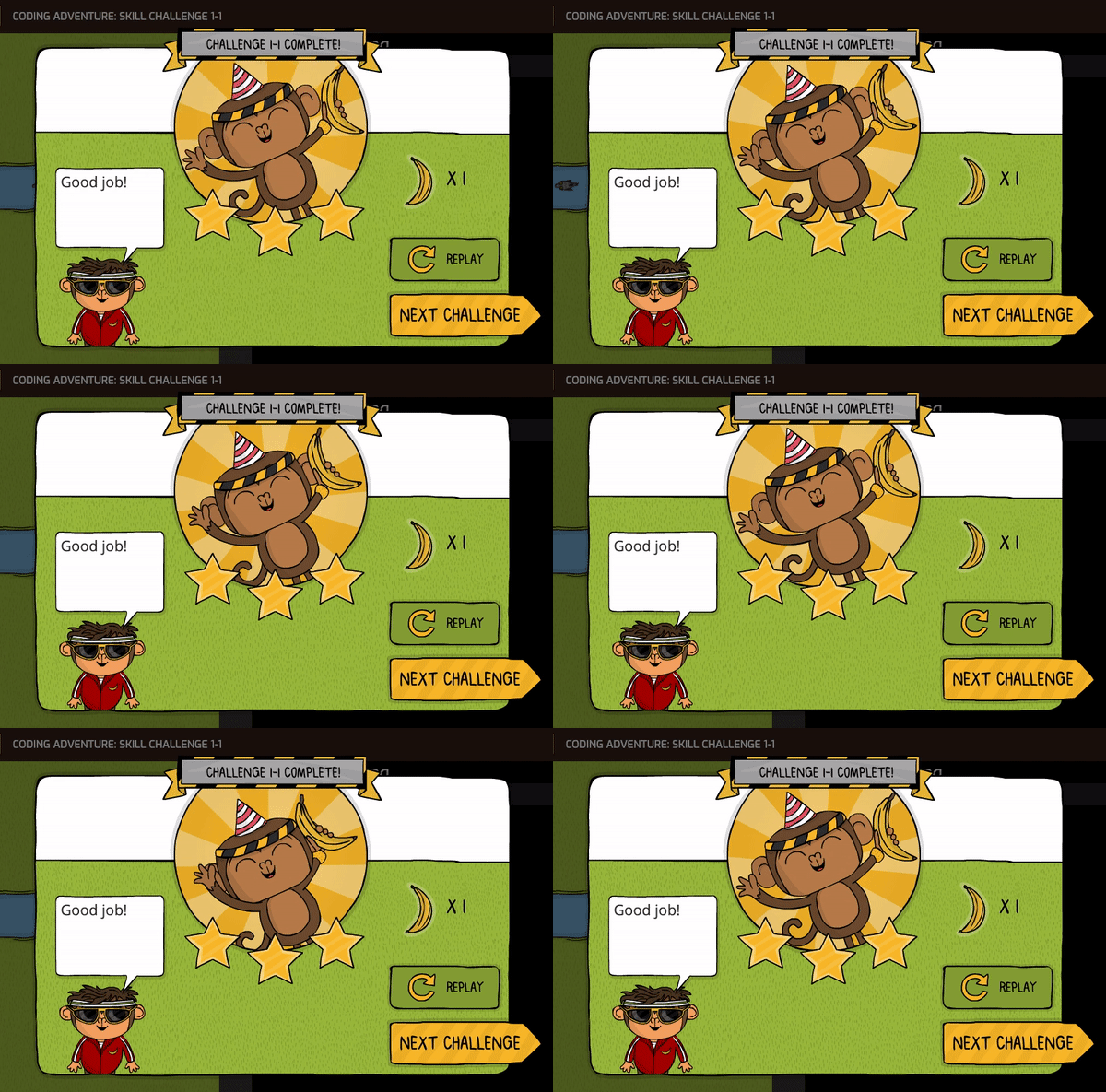
Skill Mode challenges provide students with further practice on previously completed Coding Adventure, or Story Mode, challenges.
Students will create their own challenges using Challenge Builder, a creativity platform that comes with Coding Adventure.

Coding Adventure covers coding concepts in a fun and gamified manner that meets the latest in curriculum standards.

Each challenge is automatically graded and provides students with personalized hints and tips.

Foster the development of executive functioning skills, such as problem-solving and planning.

Enjoy standards-aligned lesson plans, easy classroom management, teacher support and more!

No prior coding experience is needed to successfully roll-out Coding Adventure in the classroom.
Coding Adventure is an interactive coding course designed to introduce students to the fundamentals of computer science through engaging, story-based challenges. Learners guide characters through a series of adventures by writing code that solves puzzles and completes tasks. This approach helps students understand how programming logic works in a practical, hands-on way.
By combining storytelling with structured coding exercises, Coding Adventure keeps learners motivated while teaching essential programming concepts. The course focuses on problem-solving, logical thinking, and creativity, making it an ideal introduction to text-based coding for beginners.
Introducing children to coding at an early age helps them develop computational thinking and problem-solving skills while they are naturally curious and open to learning. Early exposure ensures that children are comfortable experimenting, making mistakes, and thinking critically—habits that support long-term success in both STEM and non-STEM fields.
Courses like Coding Adventure provide age-appropriate, engaging challenges that make coding approachable and enjoyable, fostering a lifelong interest in technology and learning.
Coding Adventure is designed for elementary and middle school students, typically ages 8 to 12, who are ready to begin learning real programming concepts. It is especially suitable for beginners who may have little or no prior coding experience but are comfortable with basic reading and typing.
The course is flexible enough to support both independent learners and classroom instruction. Students can progress at their own pace, making Coding Adventure a good fit for diverse learning levels and educational settings.
Coding Adventure introduces students to a beginner-friendly text-based programming language that emphasizes real programming logic without unnecessary complexity. The syntax is designed to be accessible for learners while still reflecting how professional code is written.
This approach helps students make a smooth transition from visual or block-based coding environments to writing actual code. The concepts and structures learned in Coding Adventure can later be applied to widely used programming languages such as Python or JavaScript.
Text-based coding introduces children to the real syntax and structure used in professional programming languages. Unlike block-based coding, which is visual and simplified, text-based coding teaches learners how to write actual code, debug errors, and understand programming logic in its authentic form.
By learning text-based coding, children develop problem-solving skills, precision, and attention to detail, which are essential for both computer science and many other academic subjects. It also provides a smooth transition to more advanced programming languages like Python, JavaScript, and Java, preparing students for future STEM opportunities.
Coding is a foundational skill in today’s technology-driven world. Even outside computer science, coding helps children develop logical reasoning, analytical thinking, and creativity, which are valuable in fields like engineering, finance, data analysis, and design.
Starting with courses like Coding Adventure allows children to build a strong STEM foundation, giving them a competitive edge in future studies and careers while cultivating transferable skills that apply across disciplines.
No prior coding experience is required to start Coding Adventure. The course is built specifically for beginners and introduces programming concepts gradually. Early lessons focus on simple instructions and logical sequences, while later lessons introduce more complex structures.
Throughout the course, students receive hints, examples, and instant feedback, which helps them learn through practice and experimentation. This supportive learning environment ensures that beginners can build confidence and succeed without feeling overwhelmed.
In addition to learning how to code, students develop critical thinking, problem-solving, persistence, and creativity. Coding Adventure encourages learners to test ideas, debug errors, and refine their solutions, helping them build resilience and confidence.
These skills are valuable across many subjects and help prepare students for future academic and real-world challenges, not just in technology-related fields.
Students learning with Coding Adventure are introduced to essential computer science concepts such as sequencing, loops, conditionals, functions, and debugging. These concepts are taught through hands-on coding challenges that require learners to think logically and plan their solutions carefully.
By working through increasingly complex problems, students develop computational thinking skills that are transferable to many programming languages and real-world applications. These skills form the foundation for future learning in coding and STEM subjects.
Through interactive coding challenges, students practice identifying problems, testing potential solutions, and debugging mistakes. This iterative process encourages persistence, critical thinking, and creative problem-solving.
By learning to break tasks into smaller steps and experiment with different strategies, children gain confidence in their ability to overcome challenges both in coding and in other areas of learning.
Yes, Coding Adventure is well suited for classroom use and aligns with many computer science education standards. Teachers can integrate the course into a core CS curriculum, STEM lessons, or enrichment programs without needing advanced technical knowledge.
The course includes tools for tracking student progress and managing learning outcomes, making it easier for educators to support students and differentiate instruction. Its self-paced structure allows students to move forward as they master each concept.
Coding Adventure is a self-paced course, allowing students to learn at a speed that matches their comfort level and schedule. Most learners complete the course over several weeks, depending on how often they practice and the amount of time spent on each lesson.
Short, focused activities make the course easy to fit into school schedules, after-school programs, or home learning routines.
Coding Adventure challenges students to plan sequences, anticipate outcomes, and reason through problems step by step. These exercises strengthen logical and computational thinking, helping learners approach challenges methodically rather than randomly.
Logical thinking skills gained through coding are highly transferable—they help children in mathematics, science, reading comprehension, and even daily decision-making, fostering a mindset that approaches challenges systematically.
Necessary cookies are absolutely essential for the website to function properly. This category only includes cookies that ensures basic functionalities and security features of the website. These cookies do not store any personal information.
| Cookie | Type | Duration | Description |
|---|---|---|---|
| _codemonkey_session_rails_4 | 1 | 1 year | |
| _ga | persistent | 2 years | This cookie is installed by Google Analytics. The cookie is used to calculate visitor, session, campaign data and keep track of site usage for the site's analytics report. The cookies store information anonymously and assign a randomly generated number to identify unique visitors. |
| cookielawinfo-checkbox-advertisement | persistent | 11 months | The cookie is set by GDPR cookie consent to record the user consent for the cookies in the category "Advertisement". |
| cookielawinfo-checkbox-analytics | persistent | 11 months | This cookies is set by GDPR Cookie Consent WordPress Plugin. The cookie is used to remember the user consent for the cookies under the category "Analytics". |
| cookielawinfo-checkbox-functional | persistent | 11 months | |
| cookielawinfo-checkbox-necessary | persistent | 11 months | This cookie is set by GDPR Cookie Consent plugin. The cookies is used to store the user consent for the cookies in the category "Necessary". |
| cookielawinfo-checkbox-non-necessary | 0 | 11 months | This cookie is set by GDPR Cookie Consent plugin. The cookies is used to store the user consent for the cookies in the category "Non Necessary". |
| cookielawinfo-checkbox-other | persistent | 11 months | |
| cookielawinfo-checkbox-performance | persistent | 11 months | This cookie is used to keep track of which cookies the user have approved for this site. |
| JSESSIONID | 1 | 1 year | Used by sites written in JSP. General purpose platform session cookies that are used to maintain users' state across page requests. |
| viewed_cookie_policy | persistent | 1 hour | The cookie is set by the GDPR Cookie Consent plugin and is used to store whether or not user has consented to the use of cookies. It does not store any personal data. |
| XSRF-TOKEN | persistent | 1 year | The cookie is set by Wix website building platform on Wix website. The cookie is used for security purposes. |
Any cookies that may not be particularly necessary for the website to function and is used specifically to collect user personal data via analytics, ads, other embedded contents are termed as non-necessary cookies. It is mandatory to procure user consent prior to running these cookies on your website.
| Cookie | Type | Duration | Description |
|---|---|---|---|
| rlas3 | persistent | 11 months | The cookie is set by rlcdn.com. The cookie is used to serve relevant ads to the visitor as well as limit the time the visitor sees an and also measure the effectiveness of the campaign. |
| UserMatchHistory | persistent | 1 month | Linkedin - Used to track visitors on multiple websites, in order to present relevant advertisement based on the visitor's preferences. |
| Cookie | Type | Duration | Description |
|---|---|---|---|
| __utma | persistent | 2 years | This cookie is set by Google Analytics and is used to distinguish users and sessions. The cookie is created when the JavaScript library executes and there are no existing __utma cookies. The cookie is updated every time data is sent to Google Analytics. |
| __utmb | persistent | 30 minutes | The cookie is set by Google Analytics. The cookie is used to determine new sessions/visits. The cookie is created when the JavaScript library executes and there are no existing __utma cookies. The cookie is updated every time data is sent to Google Analytics. |
| __utmc | persistent | 1 year | The cookie is set by Google Analytics and is deleted when the user closes the browser. The cookie is not used by ga.js. The cookie is used to enable interoperability with urchin.js which is an older version of Google analytics and used in conjunction with the __utmb cookie to determine new sessions/visits. |
| __utmt | persistent | 10 minutes | The cookie is set by Google Analytics and is used to throttle request rate. |
| __utmz | persistent | 6 months | This cookie is set by Google analytics and is used to store the traffic source or campaign through which the visitor reached your site. |
| _gat | persistent | 1 minute | This cookies is installed by Google Universal Analytics to throttle the request rate to limit the colllection of data on high traffic sites. |
| YSC | 1 | 1 year | This cookies is set by Youtube and is used to track the views of embedded videos. |
| Cookie | Type | Duration | Description |
|---|---|---|---|
| _gcl_au | persistent | 3 months | This cookie is used by Google Analytics to understand user interaction with the website. |
| _gid | persistent | 1 day | This cookie is installed by Google Analytics. The cookie is used to store information of how visitors use a website and helps in creating an analytics report of how the wbsite is doing. The data collected including the number visitors, the source where they have come from, and the pages viisted in an anonymous form. |
| GPS | persistent | 30 minutes | This cookie is set by Youtube and registers a unique ID for tracking users based on their geographical location |
| MR | persistent | 5 months | This cookie is used to measure the use of the website for analytics purposes. |
| MUIDB | 1 | 1 year | This cookie is used by MicroSoft and collects data about users of visits on multiple website. This data is used to analyze the efficiency of advertisements on websites. |
| Cookie | Type | Duration | Description |
|---|---|---|---|
| _fbp | persistent | 3 months | This cookie is set by Facebook to deliver advertisement when they are on Facebook or a digital platform powered by Facebook advertising after visiting this website. |
| bscookie | 1 | 2 years | This cookie is a browser ID cookie set by Linked share Buttons and ad tags. |
| fr | 1 | 3 months | The cookie is set by Facebook to show relevant advertisments to the users and measure and improve the advertisements. The cookie also tracks the behavior of the user across the web on sites that have Facebook pixel or Facebook social plugin. |
| IDE | 1 | 2 years | Used by Google DoubleClick and stores information about how the user uses the website and any other advertisement before visiting the website. This is used to present users with ads that are relevant to them according to the user profile. |
| MUID | persistent | 1 year | Used by Microsoft as a unique identifier. The cookie is set by embedded Microsoft scripts. The purpose of this cookie is to synchronize the ID across many different Microsoft domains to enable user tracking. |
| pxrc | persistent | 2 months | The purpose of the cookie is to identify a visitor to serve relevant advertisement. |
| rlas3 | persistent | 11 months | The cookie is set by rlcdn.com. The cookie is used to serve relevant ads to the visitor as well as limit the time the visitor sees an and also measure the effectiveness of the campaign. |
| skimCSP | persistent | 11 months | This cookie is set by SkimResources. The cookie is used to record data on the visitor to optimize the relevance of the advretisements served to the users. |
| TapAd_DID | persistent | 2 months | The cookie is set by tapad.com. The purpose of the cookie is to track users across devices to enable targeted advertising |
| TapAd_TS | persistent | 2 months | The cookie is set by Tapad.com. The purpose of the cookie is to track users across devices to enable targeted advertising. |
| TDCPM | persistent | 1 year | The cookie is set by CloudFare service to store a unique ID to identify a returning users device which then is used for targeted advertising. |
| TDID | persistent | 1 year | The cookie is set by CloudFare service to store a unique ID to identify a returning users device which then is used for targeted advertising. |
| test_cookie | persistent | 15 minutes | This cookie is set by doubleclick.net. The purpose of the cookie is to determine if the users' browser supports cookies. |
| VISITOR_INFO1_LIVE | 1 | 5 months | This cookie is set by Youtube. Used to track the information of the embedded YouTube videos on a website. |
| Cookie | Type | Duration | Description |
|---|---|---|---|
| _scid | persistent | 1 year | |
| _sctr | persistent | 1 year | |
| li_sugr | persistent | 3 months | |
| lissc | persistent | 11 months | |
| sc_at | persistent | 1 year | |
| TapAd_3WAY_SYNCS | persistent | 2 months | |
| TapAd_TTD_SYNC | persistent | 2 months | |
| u | persistent | 3 months |
| Cookie | Type | Duration | Description |
|---|---|---|---|
| bcookie | persistent | 2 years | This cookie is set by linkedIn. The purpose of the cookie is to enable LinkedIn functionalities on the page. |
| lang | persistent | 1 year | This cookie is used to store the language preferences of a user to serve up content in that stored language the next time user visit the website. |
| lidc | persistent | 1 day | This cookie is set by LinkedIn and used for routing. |